
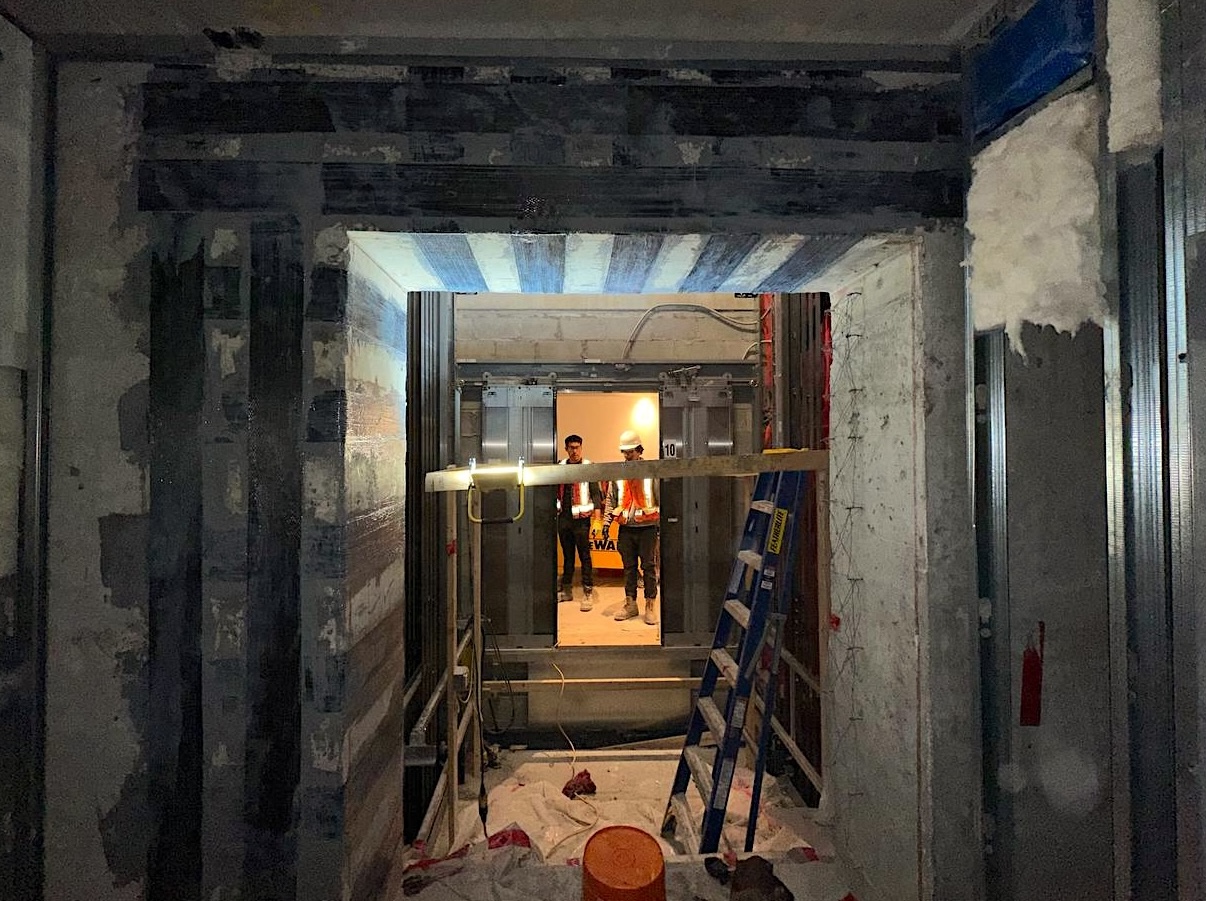
Not every concrete repair can be solved with conventional patching or standard reinforcement replacement. In some cases, the available space, structural requirements, and site limitations require a more specialized approach.
In this hotel new-construction project, RapidCrete was asked to help resolve a structural challenge inside an elevator shaft. The concrete shaft was not fully aligned with the tight dimensional requirements of the commercial elevator system, and the required correction involved removing concrete and portions of reinforcement.
The challenge was that the removed reinforcement could not simply be replaced in the same way because there was not enough room inside the shaft.
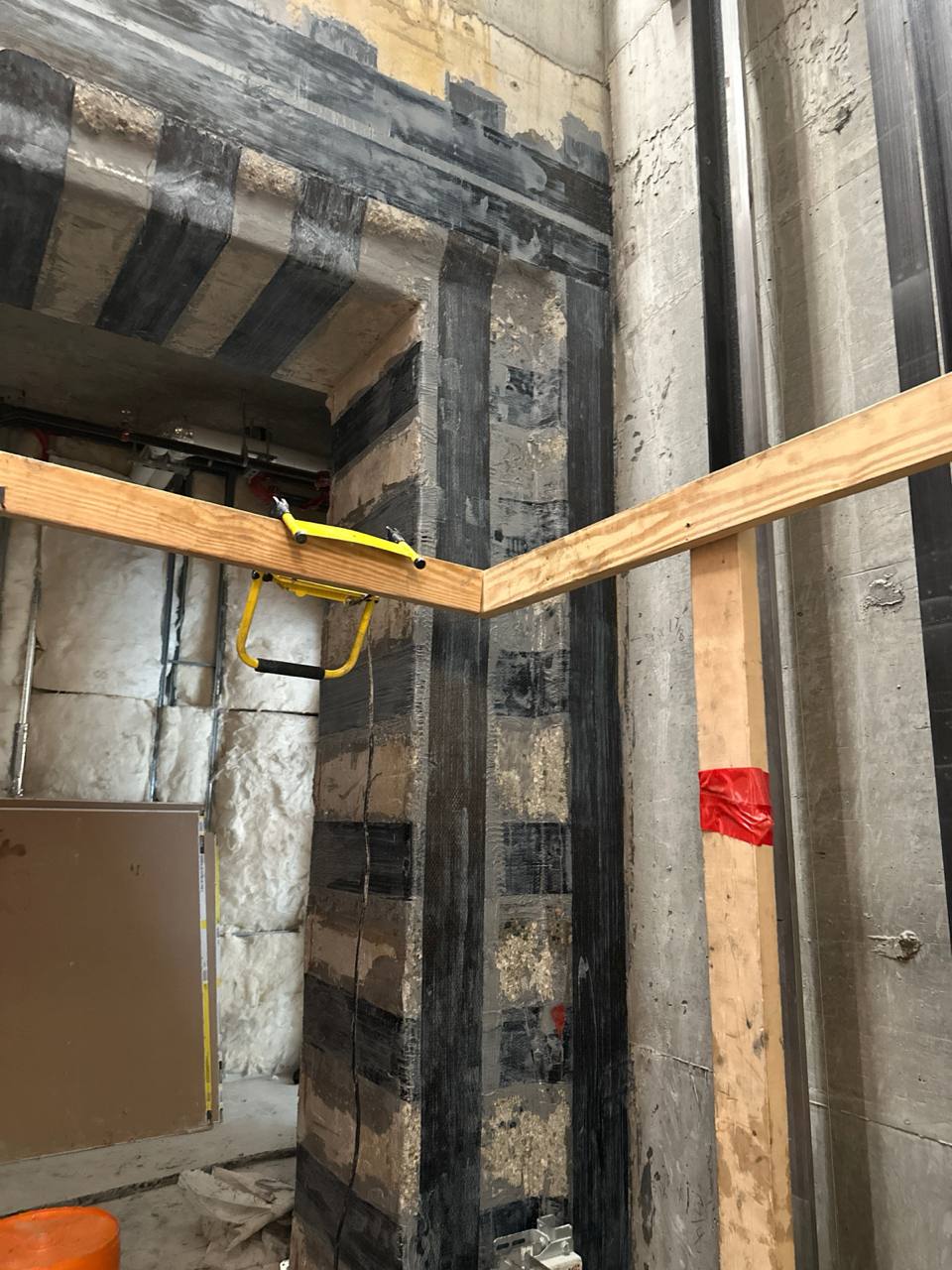
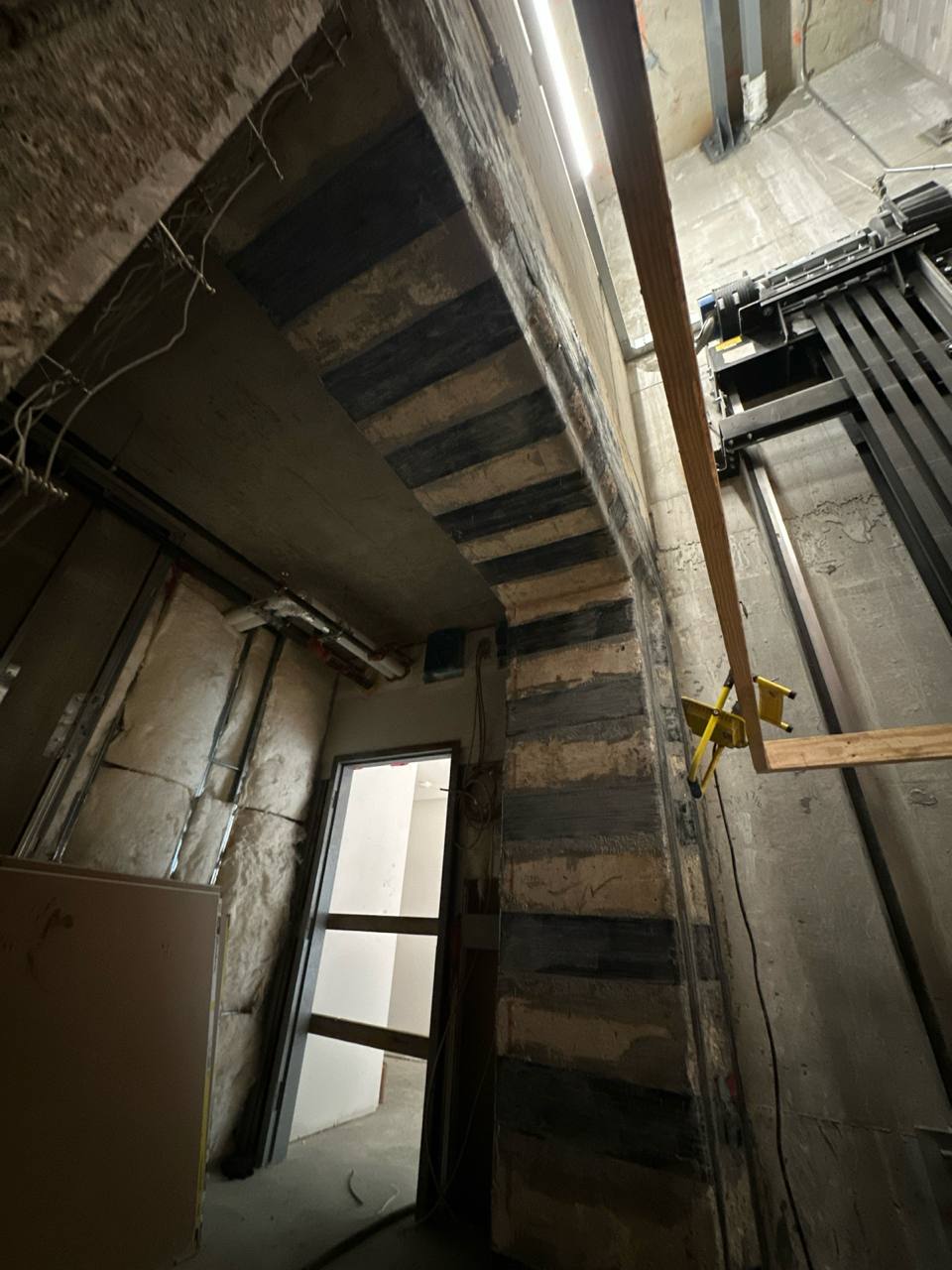
RapidCrete worked with a structural engineer to develop and execute an FRP strengthening solution that restored the required structural capacity while respecting the tight elevator shaft limitations.
Project Type: Hotel new construction
Client Type: General contractor
Structure: Concrete elevator shaft
Scope: Structural repair solution, concrete removal, surface preparation, and FRP strengthening
Key Constraint: Tight commercial elevator tolerances with limited room for conventional reinforcement replacement
The general contractor, a repeat customer, needed a practical solution that could be reviewed, approved, and executed within the physical limitations of the elevator shaft.
RapidCrete’s role was not only to perform the repair, but to help develop the repair approach and carry it through to completion.
The project presented several challenges:
This was not a simple patching scope. It required a structural solution that was technically sound and practical to execute in the field.
Commercial elevator systems allow very little room for error. In this project, the shaft geometry required adjustment, but the structure could not be modified freely.
Some concrete and reinforcement had to be removed, but the available space did not allow the same reinforcement to be replaced using a conventional approach.
This created the need for an alternate strengthening method.
Because reinforcement was removed in certain areas, the repair had to compensate for the lost capacity.
RapidCrete worked with a structural engineer to develop an FRP strengthening approach. The repair procedure was reviewed and approved before execution, and the work was completed under the supervision of the structural engineer and UOR.
The success of FRP strengthening depends heavily on the quality of substrate preparation.
In this case, surface preparation was time-consuming because of:
The surface had to be prepared carefully so the FRP system could perform as intended.
RapidCrete approached the project as a solution provider, not just a repair contractor.
The approach included:
This combination of technical input and hands-on execution helped the general contractor move forward with a practical repair solution.
The work was completed in a restricted elevator shaft environment within a live new-construction site.
The execution involved:
The repair was completed successfully and allowed the project team to move forward within the required elevator shaft constraints.
The project was completed successfully.
Key results included:
The project demonstrated RapidCrete’s ability to support complex repair situations where the solution is not obvious at first glance.
Some concrete repair conditions require structural thinking, engineering coordination, and an alternate strengthening approach.
When conventional reinforcement replacement is not practical due to limited space, FRP strengthening can provide a practical solution when properly designed and installed.
For FRP systems, the quality of the surface preparation directly affects the quality and performance of the repair.
RapidCrete’s combination of assessment, engineering background, repair methodology knowledge, and field execution allows clients to move through complex repair situations more efficiently.
This project highlights the importance of having a repair partner who can do more than execute a standard scope.
RapidCrete supports clients with testing, assessment, structural repair planning, FRP strengthening, grout injection, crack injection, concrete restoration, and other repair methodologies. When a project requires engineering input, shoring review, or a specialized repair approach, RapidCrete can help carry the solution from concept to execution.